AI sales coaching software: a buyer's guide for 2026
A sales manager cannot listen to every call. Coaching software can review completed sales call transcripts against the same rubric. Here is how to compare the tools, understand the category, and decide where RepVolt fits.
Call evidence
Follow one line from the call through what happened, why it matters, the areas to improve, and the next rep move.
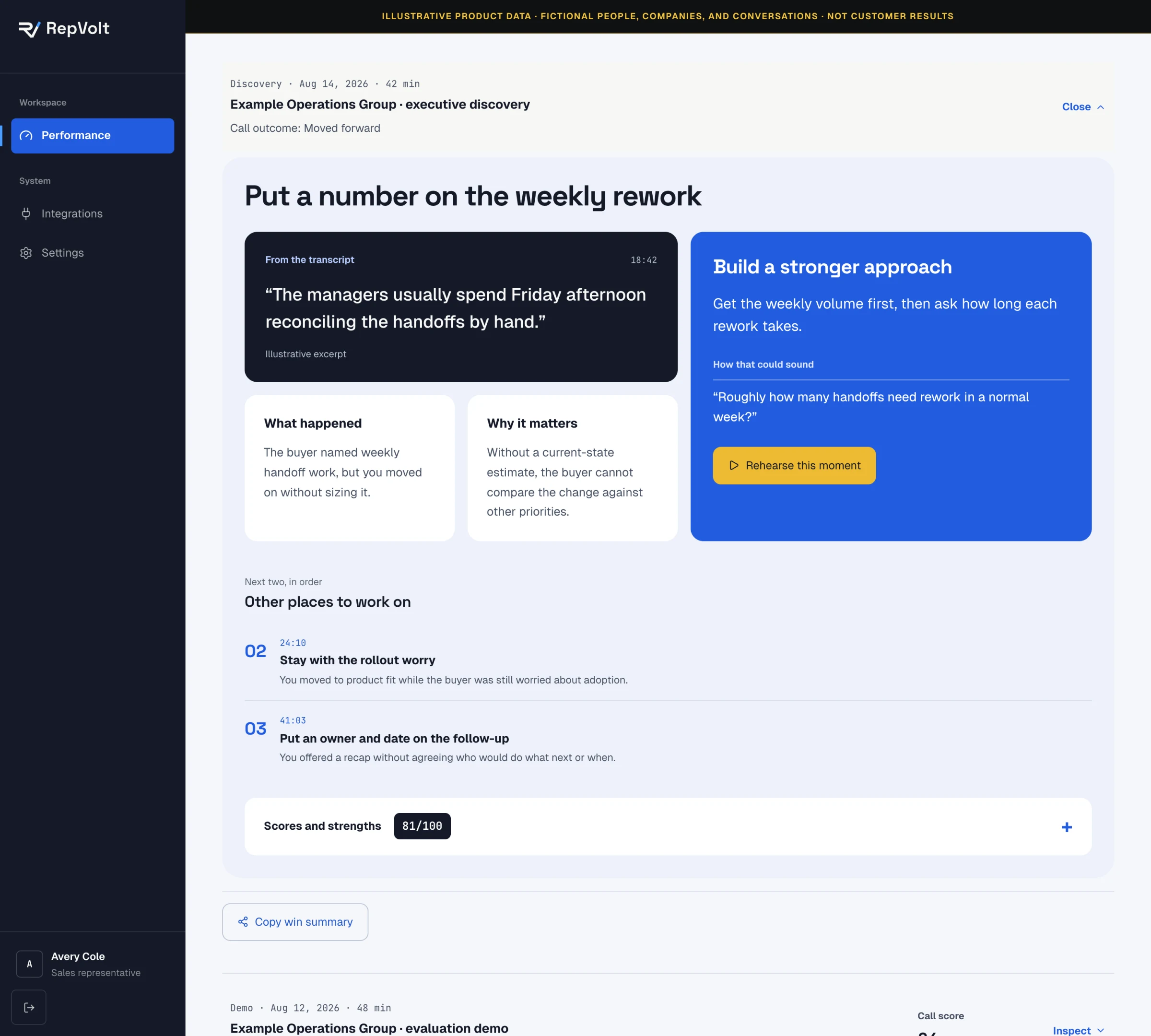
Research method: Product scope and buying motion were checked against official vendor pages on August 15, 2026, including Gong pricing, Hyperbound plans, and Outreach's pipeline management overview. RepVolt capabilities and prices come from the live product and published pricing. Verify any custom proposal directly with the vendor.
What AI sales coaching software does
Sales coaching used to mean a manager rides along on a call, takes notes, and gives feedback later. Maybe once a quarter. Maybe less.
AI sales coaching software uses automated analysis to review a call transcript against defined criteria and return some mix of scores, coaching notes, and practice. Quality and scope vary, so the useful test is whether a rep can check the evidence and act on the next step.
The goal isn't to replace the sales manager. It's to turn each completed sales call transcript into a coaching opportunity instead of just the two or three calls a manager has time to review.
Why AI coaching matters now
Three practical changes made this category useful to more teams:
- More calls are already transcribed. Teams can reuse transcripts from their recording stack instead of creating a second review workflow.
- Review capacity is finite. If ten reps each run 15 calls in a week, that is 150 conversations. A defined first-pass rubric helps a manager decide where human review is most valuable.
- Products now connect analysis and practice. The category extends beyond talk-time ratios: current tools advertise call scoring, coaching workflows, roleplay, or combinations of those capabilities.
Automated review does not guarantee that every score is correct or that every rep improves. Its role is a first pass: tie coaching notes to the call, choose what to work on first, keep the score as context, and get the calls worth discussing in front of a rep or manager.
What to look for in AI coaching software
Not all AI coaching tools are equal. Here's what separates the useful ones from the hype:
Evidence you can check
"Good call" or "bad call" doesn't help anyone. Look for coaching notes that point to the exact transcript moment behind the claim. Then check whether the scorecard fits the rep's role and call type, and whether the product says when it could not score something.
Practice generation
This is an important divider. Some tools focus on recording and analysis; others add roleplay, coach cards, learning modules, or drills. Decide whether your team needs visibility, practice, or both.
Check whether the software connects a ranked call fix to a focused rehearsal. The practice should target a specific gap from your call while using a new fictional buyer, not pretending to replay the conversation.
Price transparency
A custom quote is not automatically a bad fit; it often accompanies integrations, services, security review, and enterprise rollout. Compare the complete proposal, including seats, licence fees, implementation, term, and support, with any published self-serve option.
Integration with your call recording tools
You probably already record calls. The coaching tool should work with what you have, accepting transcripts from Gong, Fireflies, Otter, Zoom, or any other source. If a tool requires you to switch your entire recording setup, that's a red flag.
The AI sales coaching market in 2026
The market breaks down into three categories. Each does something different. Here's an honest look at all of them.
Enterprise conversation intelligence (Gong, Chorus)
These are the incumbents. Gong and Chorus (now part of ZoomInfo) record calls, transcribe them, and give you dashboards full of data: talk ratios, competitor mentions, deal risk signals, pipeline forecasting. They're excellent at showing you what's happening across a large sales org.
These products are broad, and their current families can include coaching or enablement alongside conversation intelligence. The tradeoff is buying motion: Gong, for example, publishes the structure of its pricing but prepares a custom proposal based on team size and product scope.
AI roleplay tools (Hyperbound, Second Nature)
These tools let reps practice against an AI buyer persona. Useful for onboarding new reps and drilling common scenarios. Hyperbound, for example, also lists call scoring, custom scorecards, integrations, and reporting on its paid tier.
The evaluation question is how scenarios are created and connected to call performance data. Ask whether a tool keeps a specific call gap at the top of the areas to improve, and opens practice only when it has a rehearsal for that behavior. Then ask what setup is required to do that.
Call evidence into rehearsal, when the main coaching need has a drill
RepVolt takes a narrower path from call evidence to practice. Upload or paste a transcript, or connect Fireflies for automatic imports. On an active Individual trial or plan, choose past Fireflies calls to review, or skip them. New completed calls that match your settings sync automatically. Read the call evidence behind the coaching and see the areas to improve. On a paid plan, start a short rehearsal when a practice exercise matches your main coaching need. Use typed or optional browser voice controls, then check a later call and decide whether to keep it, change your approach, or move down the list. The call score stays as context.
| Category | Examples | Buying Motion | Practice? | Tied to Completed Calls? |
|---|---|---|---|---|
| Enterprise CI | Gong, Chorus | Custom proposal | Varies by product | ✓ Yes |
| AI Roleplay | Hyperbound, Second Nature | Free demos; custom paid plans | ✓ Yes | ○ Available on some paid plans |
| Focused self-serve coaching | RepVolt | $29/mo individual, $24/seat/mo team | when a practice exercise matches your main coaching need | ✓ Yes |
Pro tip: Do not stop at a feature list. Check whether a rep can move from a cited call moment to a focused rehearsal, then inspect the same behavior in a later call. Later evidence can show whether the behavior appears differently without proving which step caused it.
How RepVolt works
RepVolt helps you understand where your sales approach needs work and how to improve it. Paid plans add practice when an exercise matches your main coaching need, so you can develop the skill before using it with a customer. Here is how that works.
The analysis comes back quickly and the drill runs about three minutes. A long transcript, or a busy moment on our side, can add a little to that.
Pricing: what AI sales coaching really costs
Vendor pricing changes and several products use custom proposals. The table below separates publicly stated buying motions from RepVolt's published self-serve prices instead of repeating third-party estimates.
| Tool | Price | Published Structure | What to Verify |
|---|---|---|---|
| Gong | Custom proposal | Per-user licenses plus a base fee | Products, seats, term, and implementation |
| Hyperbound | Free demo; custom paid tier | Prebuilt bots free; custom features demo-led | Seats, integrations, services, and term |
| RepVolt Individual | $29/month ($348/year) | Month-to-month | 1 seat |
| RepVolt Team | $24/seat/month founding ($288/seat/year) | Month-to-month | 3 to 15 reps |
For a 10-person team, RepVolt Team is $2,880 per year at the current founding rate (10 seats × $24 × 12). Compare that known figure with a current enterprise proposal; do not rely on an old third-party estimate for Gong or Hyperbound.
RepVolt is not pretending to replace an enterprise revenue tool. If you need org-wide forecasting, governance, and a broad integration program, go and evaluate those products on that scope. If you want to test a narrow coaching loop on one transcript, you can do that here without talking to anyone.
See a coaching grounded in your call review from one of your calls
Upload or paste a call transcript. You get something concrete to inspect. One call analysis is free, with no signup and no card.
Analyze one call freeFrequently asked questions
What's the difference between AI coaching and conversation intelligence?
Conversation intelligence captures and analyzes customer conversations, and the bigger products now bundle coaching and enablement too. AI coaching is the feedback and practice loop itself. The two overlap, so compare the actual scoring, the quotes behind the feedback, the practice, and the manager view in each product.
Do I need to record calls or can I upload transcripts?
Transcripts, not audio. We do not record calls or transcribe recordings. The free analysis and paid workspace both accept a common transcript file or pasted text. RepVolt identifies up to three weaknesses in your approach, explains why they matter, and shows how to improve them using moments from your call. The free analysis stops before rehearsal. On an active paid plan or trial, you can also sync completed transcripts from Fireflies or let another recorder send completed transcript text through your secure transcript connection.
How does RepVolt compare to Gong?
Different tools for different problems. Gong is revenue intelligence: pipeline analytics, deal forecasting, what is moving across the org. RepVolt is coaching: it cites one call and explains what to improve first. On a paid plan, it adds rehearsal when a practice exercise matches your main coaching need. Gong tells you what's happening across your pipeline. RepVolt shows each rep what to work on first and what comes next. Compare both against your team’s workflow. Read the full comparison.
Is AI coaching effective for experienced reps?
It can be, when the scorecard is out in the open and the coaching is grounded in the call. When the transcript supports a coaching note, RepVolt shows the exact line behind it. Treat scores as supporting context across comparable calls, then use a manager's judgment for deal context, strategy, and exceptions.
Can I use RepVolt alongside my existing tools?
Yes. RepVolt does not replace your CRM, your dialer, or your sequencing tool. The free analysis and paid workspace both accept a common transcript file or pasted text. On active paid plans and trials, Fireflies syncs completed transcripts and another recorder can use your secure transcript connection.
What does AI sales coaching software cost?
Prices and buying motions vary. Gong and Hyperbound prepare custom proposals, while RepVolt publishes its price: one free call analysis with no signup and no card, $29 a month for the Individual founding plan, and $24 per seat for the Team founding plan with a 3-seat minimum, so $72 a month for a team of 3. Month to month, cancel anytime. See RepVolt pricing.